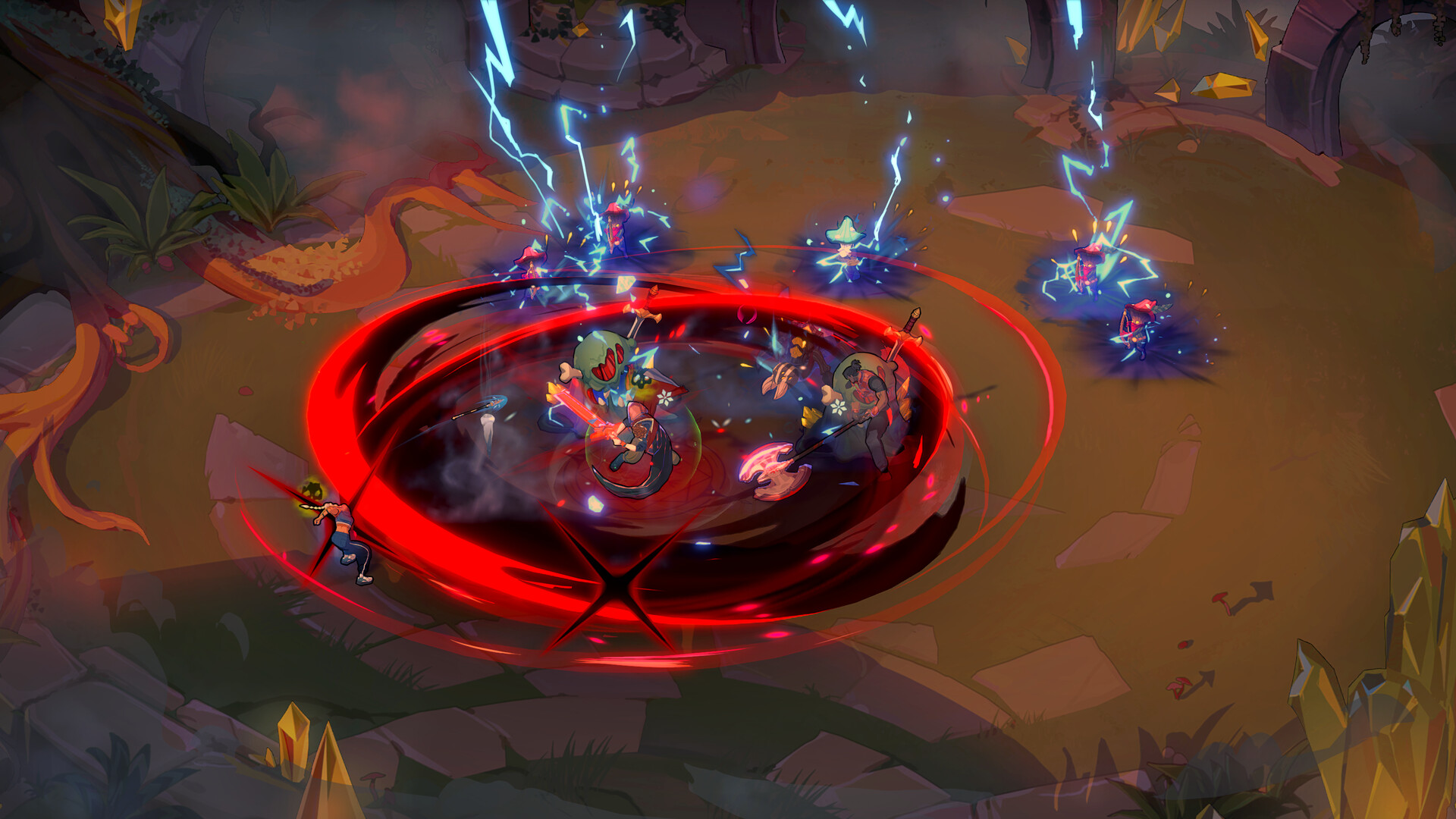
Community templates are shown with their limits. No entry is presented as an official recommendation or an independently reproduced current-patch result.
The Guildrun meta is a practical snapshot of community-observed directions for the current Demo, not an official recommendation or a permanent hero ranking. Guildrun is a single-player PvE autobattler where draft offers, specializations, items, relics, positioning, difficulty, and patches all change a run’s best decision. The entries below make their evidence visible: official material establishes the Demo and Update 0.5.1 context, while community databases provide named templates. None of the listed templates has a public, independently reproduced 0.5.1 result on this site, so each carries a retest label. Use a trend only after checking that your run already has its core trigger or role coverage. If it does not, keep the board stable and pivot toward the useful offers you actually receive.
What the current Guildrun meta favors
The latest official balance notes are the clearest guide to what a “meta” label can safely mean right now:
- Mode matters. Leyline found broad viability below SSS, while clearer hero and specialization outliers appeared in Red Rift and deep Endless.
- Shared engines matter more than isolated picks. The public community templates group heroes around Rush triggers, Shard generation, or delayed Stall effects.
- The patch is part of the build. Update 0.5.1 changed several high-difficulty outliers and fixed trigger behavior, so a pre-patch screenshot is not a current conclusion.
- Adaptation remains the official framing. The Demo asks players to reshape a run around the offers they receive rather than follow a PvP-style mandatory composition.
Current Guildrun meta at a glance
This table compares the best-documented community templates, not a verified hierarchy of the best Guildrun builds. Evidence level and version check are deliberately as prominent as the team name.
| Trend | Focus | Best fit | Evidence level | Version check |
|---|---|---|---|---|
| Rush Duelists | Team composition | Community tier-list template; its exact mode, run sample, and post-patch performance are not published. | Retest required | Community template requires a 0.5.1 retest · checked July 25, 2026 |
| Shard-generation Assassins | Relic engine | Community tier-list template only; the source does not publish current-patch win-rate samples or a mode-specific methodology. | Retest required | Community template requires a 0.5.1 retest · checked July 25, 2026 |
| Stall Spell Team | Team composition | Community tier-list template; no verified public mode, sample size, or current-patch result accompanies it. | Retest required | Community template requires a 0.5.1 retest · checked July 25, 2026 |
Guildrun meta builds and team comps
These Guildrun meta builds are editorial summaries of traceable community templates. They identify the engine, conditions, and risks instead of telling every player to copy an exact board. The three entries below should be treated as directions for a compatible draft, not checklists to force through rerolls.
How to read a Guildrun tier list
A Guildrun tier list is useful only when it shows its mode, date, evidence, and patch context. A high-SSS, Red Rift, or deep-Endless result may rely on a long scaling window, specific relic family, or a hero interaction that does not exist in a fresh lower-difficulty run. The developer’s 0.5.1 notes make this distinction explicit: lower difficulties showed broad viability, while the more notable outliers appeared at the high end.
Read each rank as a community claim to inspect, not an instruction to ignore your board. Check whether the listed engine is already appearing, whether the team can survive before it scales, and whether the cited data predates a balance change. A dated but transparent template is more useful than an unexplained S label.
How to pivot when a meta setup is incomplete
- Name the engine first. Is the direction asking for Rush, Shards, Stall, shielding, debuffs, or another repeated trigger?
- Keep the current board alive. Do not sell stable frontline or support coverage solely to chase a missing community core.
- Commit only after the trigger appears. A payoff relic without a generator, or a carry without support, is usually a reason to wait rather than force.
- Prefer the offered function. A useful tank, damage source, or support can preserve a run even when it is not the hero name in a template.
- Recheck after a patch. Mark older setup notes as provisional until they have a matching Demo version or a fresh run record.
Patch watch and evidence limits
The current page is checked after Update 0.5.1, but the cited community templates do not expose a matching public version label. That is why their cards say Retest required rather than “current S tier.” The following table separates what the developer’s patch notes establish from what still needs a current community or independent result.
| Watch item | What Update 0.5.1 establishes | How to use the Meta page |
|---|---|---|
| Difficulty context | Below SSS, the developer found broad hero and strategy viability; the clearer outliers appeared in Red Rift and high Endless. | Do not convert an endgame community ranking into a universal beginner rule. |
| Rush interactions | Rush trigger counting was fixed; Rip and Nyx interactions were affected, while the developer expected Rush builds to remain playable. | Recheck any older Rush screenshot, log, or tier entry before calling it current. |
| Shield / Mystic scaling | Kai, Gustav, and Grace all received balance attention for higher-difficulty performance. | Treat older shield and deep-Endless claims as patch-sensitive, not evergreen advice. |
| Assassin / Shard setups | Zuri and Hoyoung received buffs while Dragomir's Sanguine specialization was reduced. | A named Assassin template needs a new result, not an inferred post-patch rank. |
Frequently asked questions
What is the Guildrun meta?
The Guildrun meta is the collection of community-observed strategies that are currently receiving the most attention for particular modes or difficulties. It is not an official game system or a permanent list of mandatory heroes.
What are the best Guildrun builds right now?
There is no independently tested universal best-build ranking on this page. The documented Rush, Shard-generation, and Stall templates are useful community starting points, but each needs to be checked against the current Demo patch and the offers in a specific run.
Is there an official Guildrun tier list?
No official static tier list is cited here. Leyline's balance notes distinguish lower difficulties from SSS, Red Rift, and deep Endless, so a community ranking only makes sense when its mode, date, and patch context are visible.
Can I use a meta build without every listed item or relic?
Yes, if you preserve the build's engine rather than chasing every name. Keep the trigger, scaling source, or role coverage that makes the template work, then prefer a stable offered pivot when a core piece never appears.
Which Guildrun Demo version is this page checked for?
This page was checked on July 25, 2026, after the public Demo Update 0.5.1 balance notes. Community database entries without a matching update label are marked for retesting rather than treated as current-patch proof.
Are these recommendations independently tested?
No. The page separates official patch facts from community data and reports. It uses Community reported or Retest required until a current-version reproduction record exists.
Sources consulted
Official sources are used for Demo scope, patch facts, and current version context. Community data is used for named templates and must stay labeled as such. All listed links were checked on July 25, 2026.